Warung Bebas

Jumat, 09 Juli 2010

Midnight Sun


So, I thought I sucked at running trail races.... well you should see me in a kayak race.

The Yukon River Quest is a 740 km canoe and kayak race from Whitehorse to Dawson City in the Yukon.
Bill Nightingale and I joined on a whim last October not really knowing what we were getting ourselves into.
Karen asked if I looked at the videos on You Tube about Five Finger and Rink rapids along the course, or the warnings on Lake Labarge, but told her I did not because I did not want to scare myself out of it.

When we arrived in Whitehorse three days before the race to get our gear in order and do a 20km test paddle of our rented kayak, it was mid 20's and sunny. And sunny around the clock since it was Midnight Sun in the north. I have a picture of me standing in the main intersection of town showing the time on my watch (midnight) with daylight equivalent to an afternoon here.

But on race day the temperature plummeted to +8 and rain with river temperatures about the same.

To make things interesting the start line is 400 meters away in the park with a sprint to your boat. Being gentlemen we let everyone else go ahead while we strolled down to the waters edge, and casually got into our kayak. This turned out to be a smart move because we passed people on the water who were trying to paddle and get their spray skirts on or readjust gear that they inadvertently kicked or nudged out of position.

My biggest worry was Lake Labarge because of stories I had heard.
Well the stories were tame compared to the lake.
Five foot waves coming from behind, with a wind that came from the side and a kayak that wanted to act like a submarine.
I had a death grip on the paddle and stroked like a mad man just so I could get off the section of water. Problem is that it is around 50km long.

We made it to the end of the lake and went ashore at the checkpoint. We were both soaked and frozen.
A change of clothes and some hot tea got us back into the right frame of mind.

We were told later that a large number of boats (21) had scratched by the end of the lake. Weather and water conditions took its toll on even the hard core teams.

Now with 12 hours under our belt we would paddle through the midnight sun, finding out the hard way of sleep deprivation. Oh... the things you think you see.

We took a number of short cat naps trying to keep us from falling asleep paddling and rolling the kayak over.

Around noon we decided we had to get out of the boat to stretch only to find a patch of grass that made a nice mattress.

At the second last checkpoint we were told we had 60-ish km to Carmacks and only 4 1/2 hours to do it in. But then a huge black sky rolled in over the ridge with promise of lightning and heavy rain. We may not be the sharpest knives in the drawer but we knew not to be on the river during lightning activity.
The storm was fast and furious and ate up a half hour while Bill and I sat under a ledge.

Now we are paddling our guts out to make the deadline.

Our dash to the finish with everything we have, was to a bend in the river. But turned out short by approximately 2km's. I had miss read the map!

Now we try to keep the power stroke going but as we turn the last bend to the dock in Carmacks a fellow on the dock is shacking his head.

We were 35 hours and 5 minutes. Five minutes over the cut-off time.

They apologised as they cut our race numbers off.

We are officially out of the race.

Over 340 km's we had paddled in one of the most remote river conditions in Canada and we are short by 5 freaking minutes.

Were we disappointed?
No, because we now know what to expect next year.

Kamis, 08 Juli 2010

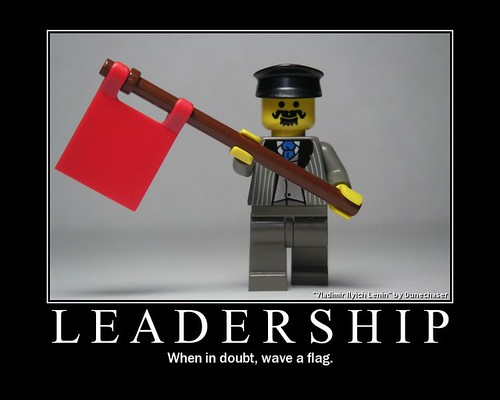
Lab Leadership

Matt Welsh has a nice post today, "the subtle art of managing a research group". I liked this quote a lot:
"..the book on motivating people gets into the various ways of getting your "employees" (a.k.a. students) to be productive, and talks all about the pros and cons of the carrot versus the stick. Synopsis: If you can get inside the head of an unmotivated student and figure out what they want, you can motivate them to do anything."
Image by Dunechaser
This is definitely my preferred management style, in both academia and industry. For my students, I try to figure out what it is that they really enjoy doing and really want to do, and try to support them in doing it.

Perhaps my most important epiphany, though, has been the realization that different people need to be managed differently. I think a good manager is able to adapt to the needs of their employee/student. And, also, realizing the way you would like to be managed yourself is not necessarily the way everyone else would like to be managed.

For example, my preferred management style (as both a manager/advisor and employee/student) is hands-off-but-available. I absolutely abhor being micro-managed, and equally abhor micro-managing others. However, there have been several occasions where I had to micro-manage someone. There was just no other way - they were incapable of self-directing. (While I think industry tolerates such people, I suspect they would utterly flop in academia).

I love how Matt writes about his advisor using Jedi mind tricks to subtly nudge his students to do things. My advisor does this too, and it's just incredible. I'm very direct - when I'm reviewing someone's work, I simply say, "I think you should do X, Y, and Z." Whereas my advisor can beautifully phrase things in such a way that you never realize until long afterward that you've been nudged.

China Study Problems of Interpretation

The China study was an observational study that collected a massive amount of information about diet and health in 65 different rural regions of China. It's been popularized by Dr. T. Colin Campbell, who has argued that the study shows that plant foods are generally superior to animal foods for health, and even a small amount of animal food is harmful. Campbell's book has been at the center of the strict vegetarian (vegan) movement since its publication.

Richard from Free the Animal just passed on some information that many of you may find interesting. A woman named Denise Minger recently published a series of posts on the China study. She looked up the raw data and applied statistics to it. It's the most thorough review of the data I've seen so far. She raises some points about Campbell's interpretation of the data that are frankly disturbing. As I like to say, the problem is usually not in the data-- it's in the interpretation.

One of the things Minger points out is that wheat intake had a massive correlation with coronary heart disease-- one of the strongest correlations the investigators found. Is that because wheat causes CHD, or is it because wheat eating regions tend to be further North and thus have worse vitamin D status? I don't know, but it's an interesting observation nevertheless. Check out Denise Minger's posts... if you have the stamina:

The China Study: Fact or Fallacy

Also, see posts on the China study by Richard Nikoley, Chris Masterjohn and Anthony Colpo:

T. Colin Campbell's the China Study
The Truth About the China Study
The China Study: More Vegan Nonsense

And my previous post on the association between wheat intake and obesity in China:

Wheat in China

Selasa, 06 Juli 2010

Who are I?

Image by xrrr
I'm far too much of a blogger newbie to do the "who are you, dear readers?" meme, since I think there are only about four of you who read this :-), so instead I'll do a reverse one, FAQ-style.

Who are you exactly?

I'm trying this pseudo-anonymity thing. I think it's probably ludicrous, because there are just so few academic female computer scientists I'm sure I'll be outed one day by some clever, bored black hatter, but hey, worth a shot.

What is your background?

I worked in industry for quite awhile, and was really enjoying it, but I felt like career-wise I had two choices in front of me: either become a manager or become a super-code-monkey. To do the former, I felt like I had to start building sentences that contained the words "synergistic leverage goals", and no matter how many fancy titles they give you I just didn't see being a code-monkey a sustainable career.

Code Monkey? Don't you mean "software engineer"?

Oh, right, sorry. Would you prefer Software Simian?

So why academia?

I wanted a career-path change. I decided if I got a PhD and became a professor, I could research whatever I wanted and (sort of) be my own boss. Most importantly, I wouldn't ever have to use the word synergy if I didn't want to.

Why do you blog?

After reading this book, I decided to get a TT job I'd need lots of (good) publications. So I spent a lot of my time early on focusing on that. Then I started talking to people who said, "Ha ha, big deal. Everyone has lots of publications. You'll also need a network of Turing Award winners to get you a job in this market."And so on. So I realized there's a lot of these little things no one tells you but you absolutely need to know to make it. I figured I'd share those things with the masses in case they were useful to others, and hope that they'll share some back.


things are still chaotic....but these five minutes sitting here staring at pictures, listening to pandora (brandi carlile) is the BEST ever.
back to reality....

*images courtesy of ruby press, compulsively compiled, oh hello friend, apartment 34, renae moore blog
 

ZOOM UNIK::UNIK DAN UNIK Copyright © 2012 Fast Loading -- Powered by Blogger