Warung Bebas

Rabu, 14 Juli 2010

Don't drunk dial the program chair

Part of being able to weather the storms of science is to recognize that generally the peer-review process is a meritocracy, but -
- The world is an unfair place
- Bad things happen to good people and vice-versa
Photo by jaycoxfilm

Sometimes you will have reviewers who miss the point. Sometimes people in positions of power over some aspect of your career (PCs, editors, funding bodies) will make large-scale decisions for their organization which leave you holding the short end of the stick. Sometimes people won't hire you.

In the end, it's entirely up to you to decide how to move forward. Lick your wounds before trying again, vent to friends, go for a jog. Whatever your coping strategy, though, sending an angry, reactionary, uninvited email to the committee is unlikely to help your case, and in general just reflects poorly on you.

That isn't to say one shouldn't make a fuss when warranted. For clear cut cases of racism, sexism, cronyism,  etc., such a response may be perfectly appropriate. But in general, if it's just a rejected paper, in the long run it's probably best to just move on and try again somewhere else.

Senin, 12 Juli 2010


sometimes i find myself wishing i could see the future for one split second....

*images courtesy of unknown, the neotraditionalist, living etc

Minggu, 11 Juli 2010

The elephant in the room

Both GMP and Pika have posts about being frequently barraged about "where they're from" due to having accents not frequently heard in the places they live. Both posts discuss how to deflect conversations when the questioners seem to lose all sense of social graces and just start acting dumb.

Image by movimente
As a native English speaker I fortunately haven't encountered this problem, and the only other foreign language I speak people are far too nice and socially conscious to ask such questions. However, I think the "where are you from?" question belongs to a larger issue, and that is the case of being Other.

When you are Other, due to nationality, gender, ethnic background, socioeconomic status, disability status, parental status, marital status, sexual orientation, (and countless other things), some people find themselves unable to restrain themselves and feel like they must point out that you are Other.

I find this usually happens in one of two ways - either someone is over-the-top direct in their comment, or they attempt to be indirect and bury themselves in the ground faster than you can say "shovel".

An example of the direct case. I am sitting with a large group of male computer scientists. Someone makes a comment about the lack of women in technology, and the sea of male faces turn to me expecting an Insightful Comment about the topic. I don't always have a good answer, and may feel a bit uncomfortable being asked to represent all women, but I generally don't mind because usually these commenters have good intentions.

The indirect case is what drives me nuts. This is when you can tell the person is feeling extremely uncomfortable about The Others, but isn't really aware that they're uncomfortable, and just starts talking talking talking, oblivious to the hole they are digging and the sea of uncomfortable faces around them.

For example, I was once at a conference that happened to have a fair number of women in attendance. Not the majority, or even half, but certainly more than at most CS conferences. At one break I was chatting with a female friend, and this older, caucasian man joins the conversation. He says, "Wow! There are a lot of women here. I'll tell you, I sure feel like a minority at this conference."

Recently I was at a large gathering of engineers. The gender mix was ok (though I'm not sure how many women were engineers and how many were spouses), but the racial mix was pretty abysmal. I saw a few people of east asian decent, and two people of african descent, but that was it.

Early at the gathering I found myself in a group chatting with three caucasian men: Emeritus professor (EP), career postdoc (CP), and my friend. EP asks my friend where he's from. My friend tells him he's from Southern State. EP starts talking about how he visited a city in an adjacent Southern State, and starts talking about how he rode the subway there. Then he says, "It was amazing. I got on the subway, and I was the only white man there. Everyone was black. I felt so uncomfortable."

And he keeps talking. And talking. And talking. And keeps looking over at me to make some kind of comment. Then CP attempts to help(?) this conversation by slightly changing the topic to once while traveling being lost in a bad neighborhood where people were shooting up heroin. Then EP starts to talk about his other travels, and says that his son married "a girl" from a southeast asian country, and how when he visits her family there ("who are lovely, by the way"), he is often the only white person.

At this point I want to punch the guy, but more importantly I don't want the Others at this party to overhear EP running his mouth. They deal with this crap every single day, perhaps are even already dealing with this at this party. So I loudly interrupt his diatribe.

"SO! I HEAR YOU DO OPTICS RESEARCH?"

He happily switches to talking about lasers, and all is right in the world again.

So in short, my approach to dealing with clueless people who seem to be unable to control their mouths is to change the topic, bluntly and directly if need be, back to science, the weather, sports, movies; whatever neutral topic I can think of. If they are so clueless that they don't understand my deflection and continue to make rude remarks about  Otherness, I keep trying to change the topic. If they still don't get it and it's someone I need to interact with frequently, sometimes I'll pull them aside and say, "Please stop talking about X. It's unprofessional and makes me feel like an Other."

Jumat, 09 Juli 2010

Midnight Sun


So, I thought I sucked at running trail races.... well you should see me in a kayak race.

The Yukon River Quest is a 740 km canoe and kayak race from Whitehorse to Dawson City in the Yukon.
Bill Nightingale and I joined on a whim last October not really knowing what we were getting ourselves into.
Karen asked if I looked at the videos on You Tube about Five Finger and Rink rapids along the course, or the warnings on Lake Labarge, but told her I did not because I did not want to scare myself out of it.

When we arrived in Whitehorse three days before the race to get our gear in order and do a 20km test paddle of our rented kayak, it was mid 20's and sunny. And sunny around the clock since it was Midnight Sun in the north. I have a picture of me standing in the main intersection of town showing the time on my watch (midnight) with daylight equivalent to an afternoon here.

But on race day the temperature plummeted to +8 and rain with river temperatures about the same.

To make things interesting the start line is 400 meters away in the park with a sprint to your boat. Being gentlemen we let everyone else go ahead while we strolled down to the waters edge, and casually got into our kayak. This turned out to be a smart move because we passed people on the water who were trying to paddle and get their spray skirts on or readjust gear that they inadvertently kicked or nudged out of position.

My biggest worry was Lake Labarge because of stories I had heard.
Well the stories were tame compared to the lake.
Five foot waves coming from behind, with a wind that came from the side and a kayak that wanted to act like a submarine.
I had a death grip on the paddle and stroked like a mad man just so I could get off the section of water. Problem is that it is around 50km long.

We made it to the end of the lake and went ashore at the checkpoint. We were both soaked and frozen.
A change of clothes and some hot tea got us back into the right frame of mind.

We were told later that a large number of boats (21) had scratched by the end of the lake. Weather and water conditions took its toll on even the hard core teams.

Now with 12 hours under our belt we would paddle through the midnight sun, finding out the hard way of sleep deprivation. Oh... the things you think you see.

We took a number of short cat naps trying to keep us from falling asleep paddling and rolling the kayak over.

Around noon we decided we had to get out of the boat to stretch only to find a patch of grass that made a nice mattress.

At the second last checkpoint we were told we had 60-ish km to Carmacks and only 4 1/2 hours to do it in. But then a huge black sky rolled in over the ridge with promise of lightning and heavy rain. We may not be the sharpest knives in the drawer but we knew not to be on the river during lightning activity.
The storm was fast and furious and ate up a half hour while Bill and I sat under a ledge.

Now we are paddling our guts out to make the deadline.

Our dash to the finish with everything we have, was to a bend in the river. But turned out short by approximately 2km's. I had miss read the map!

Now we try to keep the power stroke going but as we turn the last bend to the dock in Carmacks a fellow on the dock is shacking his head.

We were 35 hours and 5 minutes. Five minutes over the cut-off time.

They apologised as they cut our race numbers off.

We are officially out of the race.

Over 340 km's we had paddled in one of the most remote river conditions in Canada and we are short by 5 freaking minutes.

Were we disappointed?
No, because we now know what to expect next year.

Kamis, 08 Juli 2010

Lab Leadership

Matt Welsh has a nice post today, "the subtle art of managing a research group". I liked this quote a lot:
"..the book on motivating people gets into the various ways of getting your "employees" (a.k.a. students) to be productive, and talks all about the pros and cons of the carrot versus the stick. Synopsis: If you can get inside the head of an unmotivated student and figure out what they want, you can motivate them to do anything."
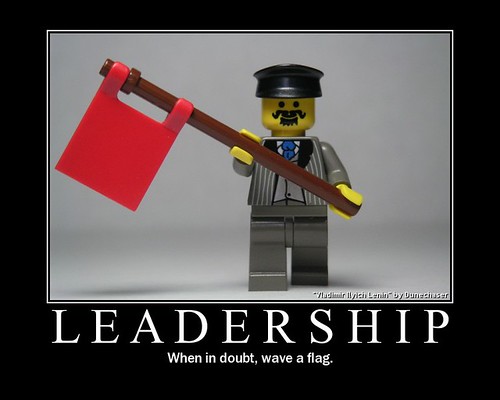
Image by Dunechaser
This is definitely my preferred management style, in both academia and industry. For my students, I try to figure out what it is that they really enjoy doing and really want to do, and try to support them in doing it.

Perhaps my most important epiphany, though, has been the realization that different people need to be managed differently. I think a good manager is able to adapt to the needs of their employee/student. And, also, realizing the way you would like to be managed yourself is not necessarily the way everyone else would like to be managed.

For example, my preferred management style (as both a manager/advisor and employee/student) is hands-off-but-available. I absolutely abhor being micro-managed, and equally abhor micro-managing others. However, there have been several occasions where I had to micro-manage someone. There was just no other way - they were incapable of self-directing. (While I think industry tolerates such people, I suspect they would utterly flop in academia).

I love how Matt writes about his advisor using Jedi mind tricks to subtly nudge his students to do things. My advisor does this too, and it's just incredible. I'm very direct - when I'm reviewing someone's work, I simply say, "I think you should do X, Y, and Z." Whereas my advisor can beautifully phrase things in such a way that you never realize until long afterward that you've been nudged.
 

ZOOM UNIK::UNIK DAN UNIK Copyright © 2012 Fast Loading -- Powered by Blogger