Warung Bebas
Tampilkan postingan dengan label mission hostile user experience. Tampilkan semua postingan

Selasa, 01 Mei 2012

Why non-medical amateurs need to be kept away from authority roles in health IT ... lest their ignorance kill people

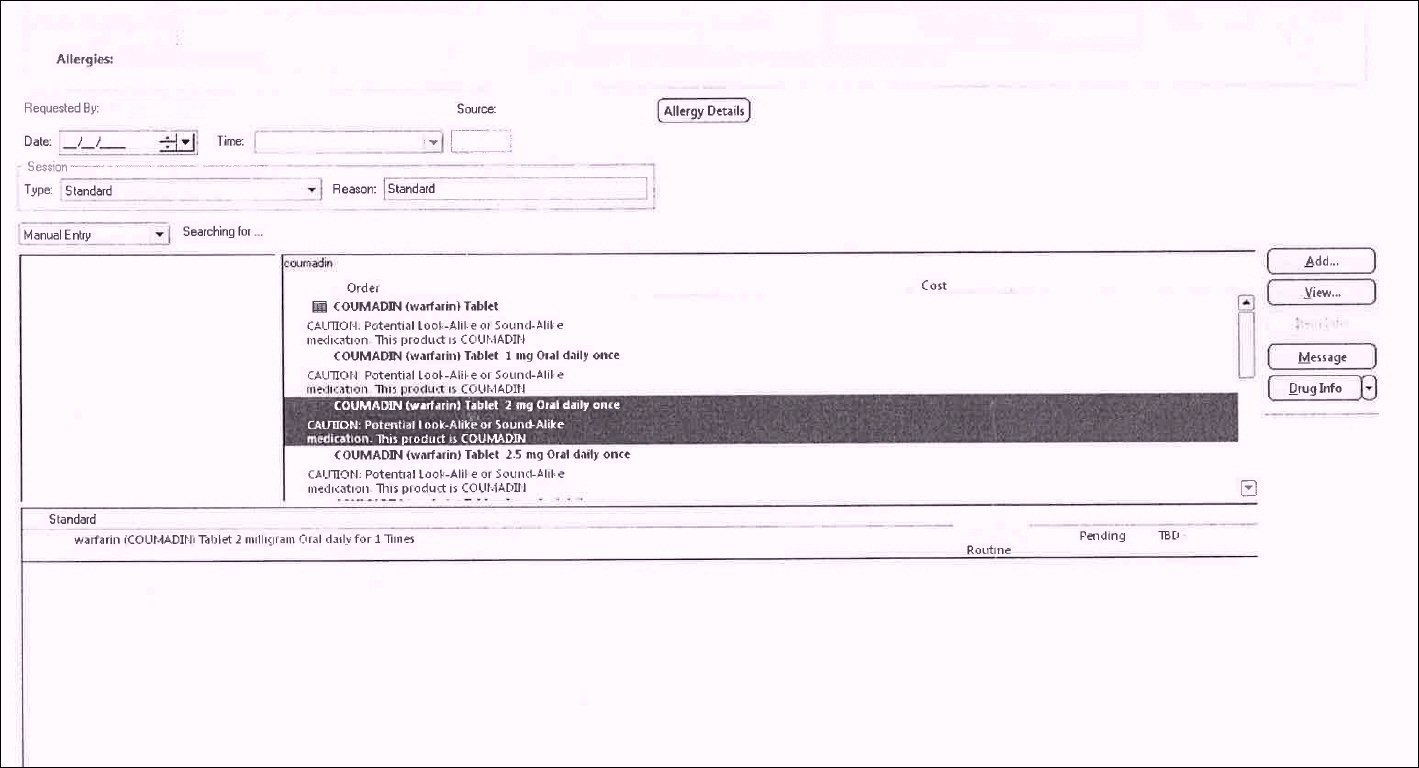
This example of a disaster waiting to happen, in the form of an error-promoting CPOE, is a poster example of why the net of litigation needs to be cast far wider than just clinicians when EHR-related errors result in injury or death:


CPOE selection screen for crucial blood thinner, coumadin (Warfarin).  Click to enlarge.


This order entry screen, from a production system (of a vendor whose stock price has recently taken a dive) shows the following.  In all fairness, I do note it's unclear if the vendor or the customer's configuration "experts" were responsible for this:

COUMADIN (warfarin) tablet 2 mg Oral daily once.
CAUTION: Potential look-Alike or Sound-Alike medication - this product is COUMADIN

with similar entries for other doses.

Below and not indented as is the selection, where the clinician is liable not to look very carefully, is the helpful interpretation:  "warfarin (COUMADIN) Tablet 2 milligram Oral daily for 1 Times."

"Oral daily for 1 Times?"

This drug needs to be given daily, generally for a very long term.  Its effect on blood clotting varies for numerous reasons in an individual over time, and needs to be checked frequently via a blood test (International Normalized Ratio or INR) to ensure the level of effect is neither too little (which could result in clots) or too much (which could result in serious or fatal bleeding).

In this case, the clinician wanted Coumadin to be administered "daily", as in "each and every day", but this was the default - daily, but only once.  "Oral daily for 1 Times."

Brilliant!  

Daily Coumadin (i.e., daily EVERY DAY), the clinician related, could be ordered only with "painstaking difficulty."

"X mg Oral daily once" is an unimaginably absurd and bizarre dosing selection to have on a CPOE system for such a critical drug - or any drug.  "Daily - once?"  

It should not, and does not, take a rocket scientist to realize this selection could quite easily lull the busy clinician into believing they have selected a dose to be continued every day - i.e., "once daily" - as per the standard usage of this drug.

To order this drug for (true) daily administration, a user must find a "repeat" icon and click the number of days the drug is to be administered.  The "repeat" icon is not readily apparent amidst screen clutter.

For other drugs, the order choices are "## mg oral daily" or similar. 

This semantic and human-computer interaction ineptitude is truly a disaster waiting to happen, especially with the medical/nursing/trainee staff turnaround that goes on in hospitals, and with the reality that clinicians are working at various hospitals with different CPOE/EHR systems.

Is this some sort scheme to prevent endless-administration Coumadin errors when the drug is actually deliberately discontinued, I ask?  If so, it's ill-conceived and dangerous at best.

By way of further information, this drug is a common anticoagulant whose use is often protective of injurious or fatal blood clots that can cause strokes or death in people with common conditions such as atrial fibrillation or prosthetic heart valves:

Warfarin is used to decrease the tendency for thrombosis or as secondary prophylaxis (prevention of further episodes) in those individuals that have already formed a blood clot (thrombus). Warfarin treatment can help prevent formation of future blood clots and help reduce the risk of embolism (migration of a thrombus to a spot where it blocks blood supply to a vital organ).

The type of anticoagulation (clot formation inhibition) for which warfarin is best suited, is that in areas of slowly-running blood, such as in veins and the pooled blood behind artificial and natural valves, and pooled in dysfunctional cardiac atria. Thus, common clinical indications for warfarin use are atrial fibrillation, the presence of artificial heart valves, deep venous thrombosis, and pulmonary embolism (where the embolized clots first form in veins).

This is an example of the kinds of mission hostility (other equally bizarre examples presented here) that results when amateurs attempt to play doctor.

I add that this type of "errorgenicity" is inexcusable.  If patients suffer harm from this type of "feature", the net of liability needs to go further than just the clinician who was caught in a web of cybernetic clinical toxicity.

-- SS

5/1/2012 Addendum:

More EHR madness and another physician, a cardiologist and electrophysiologist, who also believes these should be considered medical devices.

From DrWes blog (excerpts, and emphases mine; see entire post at link below):

The Electronic Medical Record Should be Viewed as a Medical Device 
Apr. 30, 2012

This week I received a medical record from a large academic medical center somewhere in the United States (the details were are unimportant) that has one of these new pioneering EMR systems manufactured by $13 billion-dollar company, Cerner Corporation ... what I saw was one of the better examples of how EMRs are contributing to misinformation and confusion when health care is delivered.

I received a copy of an internal medicine consult that was performed on a patient at this outside hospital. I have extracted the "medications" portion of the internist's note exactly as it was displayed in the note below ... Needless to say, I was terrified at what the system had listed as the patient's medications:

In this example, we see multitudes of medications listed more than once. We see drugs of similar classes (antihistamines, beta blockers) on the same list. We see warfarin, one of our most dangerous drugs dispensed, without a dose included. We see what seems to be outpatient meds listed with inpatient meds, I'm not sure. Honestly, we really have no idea what medications are actually being taken from this list. And yet this list of medications is listed by the EMR as the patient's "Active Medications."


Med list (page 1).  Click to enlarge; see original post for part 2.


... What the heck have we created? 
Certainly, any capable physician who cares for patients would describe this medication list as worthless.

This "med list" is similar to the list I showed at part 4 of my multi-part series on the mission hostile user experience of most commercial EHR's, from yet another system, redrawn by me in redacting the vendor ID.  These lists reflect a mercantile computing person's view of a med list as an inventory of pills:


 Another "what the heck have we created?" EHR med list, on screen. Click to enlarge.

 Dr. Wes also asks:

... So how will we measure problems with EMRs? It seems industry representatives would rather not address these concerns. We should ask ourselves, is anyone thinking about this?

Yes, they are.  And we are spreading our thinking to one place where action might actually occur sooner rather than later:  to the Plaintiff's Bar.

-- SS
Rabu, 07 Maret 2012

Using a "Professionalism" Initiative as a Speech Code to Punish Students' Criticisms of Administrative Authority?

The original impetus to set up Health Care Renewal was increasing evidence of external threats to physicians' professional values.  So it seemed to me that renewed interest in addressing professionalism in academic medicine might lead to more attention to these threats, and perhaps even real challenges to them. 

Instead, most academic professionalism initiatives seem to have steered away from this contentious area.  Worse, at times the academic medical concept of professionalism has been turned on its head. 

A Dispute Among Students at University of California - Davis

A recent post in the Torch blog from our friends at FIRE (the Foundation for Individual Rights in Education) provided a graphic example.  The case involved an apparently trivial dispute among two medical students:
[University of California - Davis medical student Curtis] Allumbaugh's ordeal began after he emailed the 'med2014' mailing list (or 'listserv') on July 19, 2010, regarding a party he was organizing. The listserv was widely used for a variety of non-academic purposes. Allumbaugh's email provided the address of the party, detailed the available space, and listed the variety of alcohol that would be available at the party. The email noted that others had signed up to bring snacks and mentioned that some things were still lacking for the party, such as music, fruit juice, and beer. Prior to Allumbaugh's message, others had sent similar emails using the same listserv about their own parties, such as a 'kegger' one student called 'CAMP MED.'

On July 20, 2010, a second-year student emailed Allumbaugh, notifying him that she had 'been placed on the class of 2014's listserve' and had monitored the class email. She criticized Allumbaugh's email for placing 'a heavy emphasis on alcohol.' In response, Allumbaugh emailed her directly on July 21, calling her a 'busy body' and telling her, 'You should really just mind your own business and let our class be.'

Note that the second-year student's email (available here) carried a suggestion that she had some sort of authority to monitor the extra-curricular actions of first year students as manifested on the list server, and perhaps even punish them for perceived misconduct:
I can tell you that as MS2s, we work and play hard, but we do it responsibly and always in the forefront of our minds we remember what image we are portraying in public and through the messages we send. I'd hate to see any one of you 2014ers get into any trouble right before you start an amazing period of your life.

Note that the exchange between the two students did not occur in an academic or clinical setting, and it was never clear why the second year student was "placed on" the list server, or why she should have any authority over the Allumbaugh. .

The School Administration Invokes "Professionalism"

The medical school saw fit to cast Allumbaugh's actions as violations of the school's standards of professionalism:
As a result of this email exchange, Associate Dean of Student Affairs and Graduate Medical Education James Nuovo sent Allumbaugh a letter on September 14, 2010, citing him for 'failing to demonstrate the highest standards of civility and decency to all' and 'failing to demonstrate courtesy, sensitivity and respect.' On November 3, 2010, Allumbaugh received a letter from the SOM Committee on Student Progress, punishing him with academic probation for the rest of his time in medical school and requiring him to undergo a psychological assessment to determine whether he was 'fit' to continue in medical school.

Finally, on November 19, 2010, SOM changed its rules to force all medical students to abide by the Principles of Community or else face academic probation.

The result was a series of interventions by FIRE:
In response, FIRE wrote UC Davis Chancellor Linda P.B. Katehi on August 3, 2011, noting that enforcing professional standards in truly professional settings differs greatly from enforcing workplace standards in other settings such as private conversations. FIRE also noted that it is blatantly unconstitutional to police student speech under the UC Davis Principles of Community because such a 'civility' policy violates the First Amendment right to freedom of speech when it is given disciplinary force.

When that letter had no effect, it took threats of litigation for the medical school to suspend Allumbaugh's punishment more than one year after it began:
SOM Associate Dean of Curriculum and Competency Development Mark Servis replied to FIRE on August 10, 2011, defending the policy. FIRE responded on November 23, 2011, reminding Katehi that 'violating well-established law regarding the First Amendment rights of students at public universities leaves you at risk of losing qualified immunity, thereby opening you and other administrators to personal liability' for the deprivation of students' First Amendment rights. Servis again defended the policy in a reply on December 5, 2011.

Finally, on February 16, 2012, the Committee on Student Progress notified Allumbaugh that his probation had been dropped, but persisted in requiring him to adhere to the Principles of Community.
Note that Associate Dean Servis' letter stated that the email sent to Allumbaugh by the second year student was "a genuine suggestion of concern and an offer of albeit unsolicited friendly advice."  Thus, Servis seemed unaware that it could have been interpreted as an assertion of authority and a threat of punishment ("I'd hate to see any one of you 2014ers get into any trouble.")

Dean Servis also defended the use of probation to punish a student for failing to "work effectively with classmates." Yet the dispute that had nothing to do with (academic or clinical) work, and only involved a single student from another class.  Why that student was not equally to blame was not clear, unless it was because she had been granted special authority by the administration to monitor the actions of less senior students.  The implication appears to be that the punishment was in defense of a student who had been granted special authority by the administration, and hence was ultimately in defense of the administration's power. 

Summary

In this case, the medical school's professionalism policy seemed to be used by the administration primarily to control students' speech outside of the academic and clinical setting. Furthermore, the student's main offense seemed to be failure to kowtow sufficiently to another student who by implication had been given some sort of authority by the administration.  What the two students' dispute had to with professionalism is not  apparent.

On one hand, this seems like a case in which a speech code was mainly used to defend administrators from criticism and challenge.

On the other hand, this speech code was cloaked in the mantle of professionalism.  So this case seems to be an example of a professionalism initiative used as an excuse for the leadership to maintain its power.

It is beyond ironic that while this was going on, the University of California - Davis, and its Chancellor Linda Katehi were becoming briefly infamous for another effort, a more violent one, by the administration to prevent criticism and challenge. Chancellor Katehi had authorized university police to "clear" student demonstrators from an "occupation" of the campus which was protesting, among other things, rising tuition and economic inequality, and in doing so, the police used pepper spray on unarmed students (see this post.)

There are a lot bigger threats to physicians' and other health care professionals' professionalism than medical students' sarcasm or even rudeness in disputes about alcohol served at off-hours parties. Since many of these threats also generate personal benefits to academic leadership, it may not be much of a surprise that they have received little attention.  (See the list of threats appended below.  Note that we have discussed two of these threats in the specific context of the University of California - Davis.  Here we noted that Chancellor Katehi seemed to be re-imagining her medical school as a biotechnology company.  Here we noted that Chancellor Katehi was also on the board of a company with a medical education and communication company subsidiary.)

However, while they remain unaddressed, I submit that using "professionalism" to cloak increased social control of students to prevent them from looking too closely at what academic administrators are doing will eventually backfire. 

===
ADDENDUM: List of Threats to Professionalism


Instead, to really uphold professionalism, we need to defend it from its real threats, as listed in my 2010 post:


  • Abandonment of traditional prohibitions of the commercial practice of medicine - In the US, a Supreme Court decision was interpreted to mean that medical societies could no longer regulate the ethics of their members.  Until 1980, the US American Medical Association had  ruled that the practice of medicine should not be "commercialized, nor treated as a commodity in trade."  After then, it ceased trying to maintain this prohibition.  The result was increasing, now rampant commercialization.  See posts  here and here.
  • Making money takes precedence over education -  A recent survey showing that more than half the faculty at multiple US medical schools felt they were valued more for how much money they brought in than their teaching or patient care abilities (here), confirming previous anecdotal reports (see here). 
  • The medical school re-imagined as a biotechnology company -  In 2000, a Vice President of the American Association of Medical Colleges(1) wrote that research universities must respond to "societal demands that they become engines of economic development…."  Many universities now defend lax conflict of interest policies with similar arguments.  For more details, go here.
  • Faculty become employees of industry - For numerous examples of this and other kinds of conflicts of interest, go here.  A survey by Campbell et al suggested that approximately two-thirds of medical academics get significant payments from industry.(2)
  • Academics become "key opinion leaders" paid to market drugs and devices - Marketers regard "key opinion leaders" as salespeople who appear more credible because of their professional guise.  See anecdotal evidence here.  
  • Control of clinical research given to commercial sponsors - A study by Mello et al showed how universities' grant administrators are willing to sign contracts giving commercial sponsors control over key aspects of human research studies.(3)  See post here
  • Conflicts of interest allow manipulation and suppression of clinical research - Commercially sponsored research design, implementation, and dissemination are often manipulated to favor the sponsor's interests.  When such manipulation fails to produce favorable results, the results may simply be suppressed.
  • Academics take credit for articles written by commercially paid ghost-writers - Such ghost-writing is often part of organized stealth marketing campaigns. 
  • Whistle blowers are discouraged, or worse, and academic freedom is damaged.  Discussion of some examples of what may happen to whistle blowers is here.  The survey mentioned earlier (here) showed that about one-third of faculty fear they may be punished for speaking  out. 
  • Leadership of academic medical centers by businesspeople - Ill-informed management may result from leaders who have no background or training in actual health care. 
  • Leaders of teaching hospitals and universities become millionaires -  A recent example is here, and more may be found here.  Leaders of academic medical centers and the parent universities of medical schools often make more than $1 million a year in the US.  When such amounts are in play, executives may focus more on short-term measures that lead to even more pay than on upholding the mission. 
  • Medical school leaders become stewards (as members of boards of directors) of for-profit health care corporations - A recent example is here, and a summary of how we discovered this phenomenon in 2006 is here.   The conflict of interest is severe because directors of for-profit corporations are supposed to have unyielding loyalty to the interests of the corporation and its stockholders, although they are frequently accused of acting mainly as cronies of the top hired executives (see here and here).
  • Leaders of failed finance firms become stewards of academic medicine - We have found numerous examples, recently here, here, and here, of top executives and/or board members of the finance firms who helped bring on the global financial collapse also being trustees of medical schools, academic medical centers, or their parent universities.  Such "stewards" may bring to the academic environment the "greed is good" culture now pervasive in finance. 
References


1. Korn D. Conflicts of interest in biomedical research. JAMA 2000; 284: 2234-2237. Link here.
2. Campbell EG, Gruen RL, Mountford J et al. A national survey of physician–industry relationships. N Engl J Med 2007; 356:1742-1750. Llink here.
3. Mello MM, Clarridge BR, Studdert DM. Academic medical centers' standards for clinical-trial agreements with industry. N Engl J Med 2005; 352: 21.  Link here.

Kamis, 02 Februari 2012

KevinMD: How algorithm driven medicine can affect (make more dangerous, actually) patient care

Reposted from KevinMD blog on another aspect of the health IT mission hostile user experience. Emphases and comments in [red italics] are mine:

How algorithm driven medicine can affect patient care
by


Whenever someone is scheduled for an operation, the assigned nurse is required to fill out a “pre-op checklist” to ensure that all safety and quality metrics are being adhered to. Before the patient is allowed to be wheeled into the OR we make sure the surgical site is marked, the consents are signed, all necessary equipment is available, etc. One of the most important metrics involves the peri-operative administration of IV antibiotics. SCIP guidelines mandate that the prophylactic antibiotic is given within an hour of incision time to optimize outcomes. This has been drilled into the heads of physicians, health care providers, and ancillary staff to such an extent that it occasionally causes total brain shutdown.

Let me explain. For most elective surgeries I give a single dose of antibiotics just before I cut. For elective colon surgery, the antibiotics are continued for 24 hours post-op. This is accepted standard of care. You don’t want to give antibiotics inappropriately or continue them indefinitely.

But what about a patient with gangrenous cholecystitis or acute appendicitis? What if, in my clinical judgment, I want to start the patient on antibiotics right away (i.e. several hours before anticipated incision time) and then continue them for greater than 24 hours post-op, depending on what the clinical status warrants? I should be able to do that right? [No - wrong - the idiots who designed your CPOE/Pharmacy IT system forgot that robotic medicine is bad medicine - ed.]

Well, you’d be surprised. [No, actually, I'm not. I'd have been more surprised to see a system not impeding critical medical decisions tailored to the individual patient - ed.]

You see, at two different, unaffiliated hospitals I cover, the surgeons have seen that decision-making capability removed from their power. If a young patient comes in with acute appendicitis and I feel that it would be prudent to continue the Zosyn an extra couple of days, an automatic stop order is triggered [presumably cybernetically - ed.] in the department of pharmacy and the antibiotic is stopped after 24 hours, no matter what. Unless the surgeon specifically writes “please do not stop this antibiotic after 24 hours; it is being administered for therapeutic purposes, not prophylaxis [that sounds a bit like begging - ed.] ,” the antibiotic will not be sent to the patient’s floor for administration. As a result, patients end up being treated sub-optimally, and potentially harmed, due to an over-emphasis on “protocol” and “quality care metrics.”

Similarly, the 60-minute timeline for pre-operative antibiotic administration can be problematic. I have had patients come into the ER with appendicitis or cholecystitis and, in my pre-op orders, write for Zosyn or whatever, to be started ASAP, no matter what time the operation is scheduled. Not too long ago, I admitted a gallbladder over the phone at 2am. I gave the nurse admitting orders which included one for a broad spectrum antibiotic.

When I saw the patient in the morning, I added her on to the OR schedule. By the time a room opened up, it was about 10:30am. The OR nurse asked me if I wanted to give an antibiotic for the case. I told her that the patient was already on antibiotics as part of her admit orders for treatment. The nurse shook her hand. It had never been given; the floor nurse held it so that it wasn’t administered until 60 minutes before the scheduled OR time, just like the algorithm dictates — despite the fact it had been ordered nearly 8 hours prior to the case, not for peri-op prophylaxis, but for treatment of an established pathology. [This is how EHR-induced malpractice occurs, readers. Guess who bears liability? - ed.]

And there it was, the cefotetan, hanging on her IV stand. Now nothing bad happened [this time, due to luck - ed.], but here you have a situation where health care providers are so terrified of violating Quality Assurance Protocol that they end up withholding necessary treatment. It’s just astounding. [It's astounding the surgeons don't simply use a scalpel on the computer terminal network and power cables to protect their patients - ed.]

As surgeons, we have bitched and moaned. You would think that these issues would be quickly rectified. But no. It is the responsibility of the surgeon to write qualifying statements [a workaround to a 'feature' that turns medical judgment on its head - ed.] for therapeutic antibiotics because the default mode is to override a licensed physician’s clinical judgment. [Not mentioned is who is overriding that judgment through cybernetic proxy - ed.]

This is what I’m talking about when I say that blind allegiance to a top-down, systems analysis-driven algorithm can turn everyone involved in health care into a bunch of mindless drones.

Jeffrey Parks is a general surgeon who blogs at Buckeye Surgeon.


I will simply add that these issues sound like poor IT/protocol design and implementation, getting in a physician's way regarding tailoring of care to the individual patient.

An inviolable rule in health IT is - or needs to be -

"You should not have to work around something that is not in the way."

There is nothing to debate or discuss on this issue.

-- SS

Feb. 3, 2012 addendum:

Some IT person (anonymously, of course) tried to argue and debate anyway; however, they did not even do basic homework. See their comments in the comments box.

Feb. 5, 2012 addendum:

More in the comments section by someone saying they made the aforementioned comments, stating they are a hospitalist, and still trying to advance the same arguments in favor of physicians adapting to mission-hostile HIT and/or protocols rather than 'protesting too much.'

Rabu, 14 Desember 2011

The EHR Mission Hostile User Experience, Part 10: Cerner Powerchart - via FDA's MAUDE Database

"You should not have to work around something that is not in the way" - SS

Some time ago, I'd written an eight part (later expanded to nine part) series on health IT mission hostile user interfaces and experiences.

(Note: Part 1 of this series is here, part 2 is here, part 3 is here, part 4 is here, part 5 is here, part 6 is here, part 7 is here, and part 8 is here. 2011 addendums: a post that can be considered part 9 is here, part 10 is here.)

Here is an addendum, part 10, from the FDA Maude (Manufacturer and User Facility Device Experience) Database. I do not know who wrote it or where it was from. It was received by FDA as indicated on 3 April 2011:


FDA MAUDE REPORT

CERNER POWERCHART

Event Type Other

Event Description

I am writing to report a problem in the design of the cerner powerchart computer provider order entry (cpoe) product. As i will describe below, these design flaws are largely responsible for approximately 100 medication errors per day in our 240 bed hosp. The (b)(6) hosp in (b)(6) is a 240 bed teaching hosp. We are owned by the (b)(6). We have to be one of the only hospitals in the country to fully implement cpoe with two entirely different electronic medical records (emr).

In 2007, we completed a comprehensive cpoe implementation using idx 3. 1 (which was later purchased by general electric). Our self-reported medication error rate was <2 error reports per day. In (b)(6) of 2010, we transitioned our emr to cerner millennium - powerchart (b)(4). This implementation was done as a first step to converge onto a single electronic medical record across the (b)(6) enterprise.

Despite extensive nursing informatics support (approx. 7000 hrs per month for the first six months after implementation), our error rate went from approx. 176 medication errors per day one month after implementation to approx. 100 medication errors per day currently. It has been stable at this level for at least the past 3 months. Many of these errors involve high risk medications (e. G. Heparin, morphine). In order to understand the etiology of the errors, i need to explain how cerner processes cpoe orders.

With cerner, orders are grouped into plans ("powerplans"). These plans can include sub-plans ("phases") and sub-sub-plans ("sub phases"). A typical orders display screen appears as follows: (b)(4). Under the plans is an order tab which displays other orders.

This design allows two distinct sources of error.

First, there is no consistent way to view orders for medications. A medication order can display either in a plan, sub-plan, or under the orders tab. In order to find a given medication, cerner mandates that you click through each and every plan. This facilitates duplication of both medication and non-medication orders (there is a medication checker which is so poorly designed and does little to aid the pharmacists in detecting duplicate medications).

Second and more dangerous, high risk intravenous medications can be run either inside or outside of the plan. Cerner programming [i.e., the user interface design -ed.] does not keep high risk medications in a consistent spot. It is very easy to stop monitoring for heparin (which is included in the heparin plan) while continuing the heparin (which is outside the plan) or vice-versa.

As you can probably guess, we formed multiple interdisciplinary teams to address these deficiencies.
[Workarounds - ed.]

I was the lead physician on the orders team. Although we were unable to reduce the error rate, it is not close to an acceptable level. Again, i believe this is because of the design of the cerner product which is why i chose to bring this to your attention. With issues this complex, i am a firm believer that "seeing is believing. " if desired, i would be happy to arrange a web conference to demonstrate my concerns.

Brand Name CERNER POWERCHART COMPUTER
Type of Device NONE
Manufacturer (Section F) CERNER
Manufacturer (Section D) CERNER
Device Event Key 2081342
MDR Report Key 2045867
Event Key 1942844
Report NumberMW5020161
Device Sequence Number 1
Product Code LNX
Report Source Voluntary
Reporter Occupation Other
Type of Report Initial
1 Device Was Involved in the Event
1 Patient Was Involved in the Event
Date FDA Received 04/03/2011
Is This An Adverse Event Report? No
Is This A Product Problem Report? No
Device Operator Service Personnel
Was The Report Sent To Manufacturer? No
Is the Device an Implant? No
Is this an Explanted Device?
Page Last Updated: 11/30/2011

I will let the FDA report speak for itself, with only one question:

When will the designers, developers, purchasers and implementers of medical devices like this start to be held criminally liable for patient injuries that occur from the risk these devices pose to patient safety?

criminal negligence - (law) recklessly acting without reasonable caution and putting another person at risk of injury or death (or failing to do something with the same consequences)

It's not as if the issues related to good user interface design are a mystery, nor have those issues been a mystery for at least a few decades.

An EHR design as described, if accurate, while perhaps "nifty" in some way from the computer-techie perspective, would require significant recklessness to design and to actually implement in a life-critical setting.

Those who try to point out these issues internally are sometimes subject to retaliation (for not being a "team player", of course, which in today's parlance means someone who is silent, or silenced, or a co-conspirator regarding managerial mediocrity, malfeasance, or madness). An example is here. We at Healthcare Renewal simply refuse membership on that team.

(Did I mention this deterministic miracle-making technology is slated via the HITECH Act for rollout in the U.S., unless the medical professional or organization is willing to accept progressive cuts to their Medicare reimbursement?)

-- SS
 

ZOOM UNIK::UNIK DAN UNIK Copyright © 2012 Fast Loading -- Powered by Blogger